
Money is quietly learning to move itself.
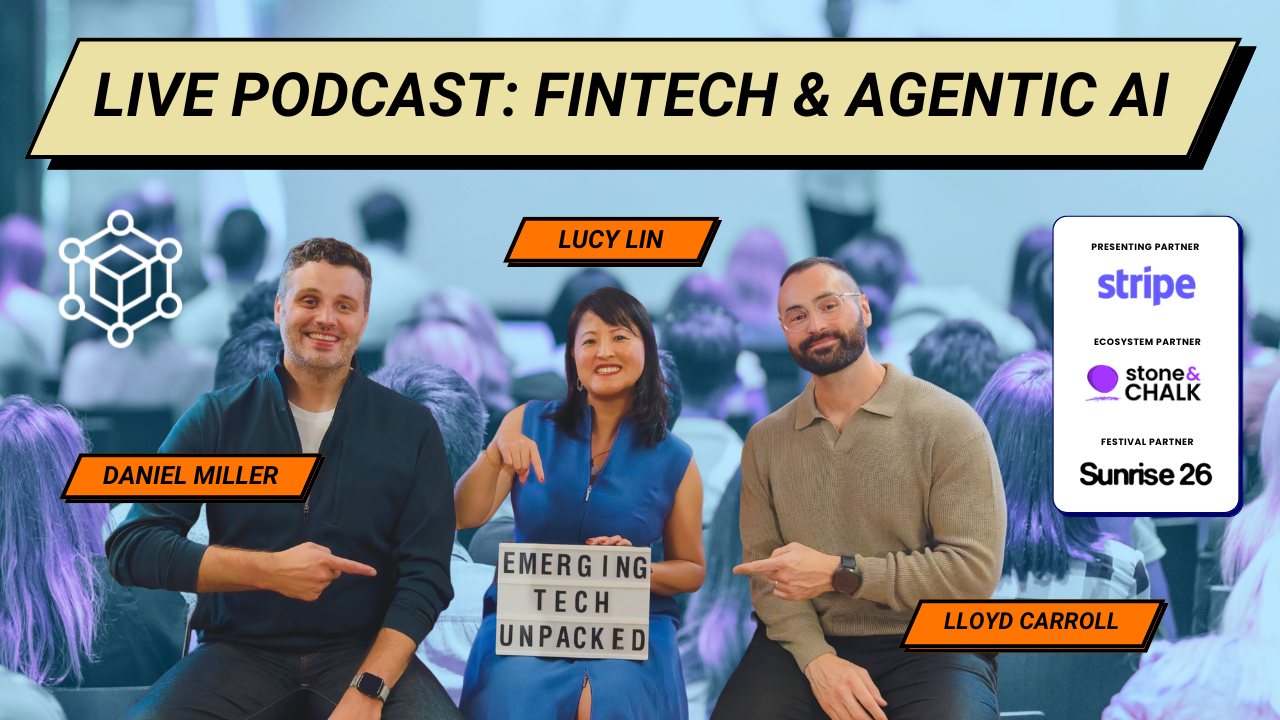
That was the feeling in the room at Stone & Chalk during Sunrise when we recorded a special live episode of Emerging Tech Unpacked on Fintech and Agentic AI with Stripe’s Head of Solutions Architecture, Daniel Miller, and splose’s Head of Payments, Lloyd Carroll.
Agentic AI is one of those phrases that sounds abstract until you see it in action. Once you do, it becomes hard to un see.
From chatbots to sidekicks that act
Most of us first met AI in a chatbox: you type a question, it replies with text. Helpful, but contained. In this episode, we explore the moment when AI stops being a conversational interface and starts becoming a doer.
Lloyd describes agentic AI as “a chat interface with a bunch of computers behind it” that can carry out tasks for you. Instead of just suggesting a plan, it can:
- Read documentation and internal notes
- Call APIs and connect systems
- Take actions like sending messages, generating reports, or even initiating payments
Daniel gives the example of Claude “co work” to control your computer and complete tasks end to end. That’s much closer to what agentic really means: always on systems with enough context and instructions to act on your behalf, not just answer questions.
It’s the difference between an assistant that drafts your email and a sidekick that reads the brief, sends the email, updates the task board, and books the follow up meeting while you sleep.
When agents start discovering products for you
One of the most striking highlights in the conversation is how customer discovery is already shifting from humans to agents.
Stripe has started seeing more traffic to its documentation from AI agents than from browsers used by humans. That means
- Software, not people, is now reading product docs
- Agents are deciding how to integrate with payment platforms
- The “customer” could be an LLM acting on behalf of a developer or a business
Daniel describes a chart with one line rising (LLMs consuming docs) and one falling (humans). It’s a quiet but profound shift: your first impression is no longer just the human developer reading your API docs, it’s the AI agent they’ve sent to scout on their behalf.
Fintech products now have at least two audiences:
- The human buyer, who cares about trust, brand, and outcomes
- The agent buyer, who cares about clear documentation, consistent APIs, and machine readable constraints
Designing for both will be an emerging key skill.
Payments: from plumbing to product
Payments often get dismissed as “unsexy plumbing” until something breaks. This episode flips that narrative.
Daniel points out that even in Australia (one of the most saturated markets for Apple Pay and Google Pay) many businesses still don’t offer these options at checkout. That’s avoidable friction with a clear impact on conversion.
Together with Lloyd’s experience, a bigger picture emerges:
- Nearly all of splose’s customer invoicing runs through their platform
- They’ve processed a substantial amount of payments over the past year
- When clients pay via online methods like Stripe, the time to payment drops dramatically compared to bank transfers
Helping a small business get paid faster is not just a UX tweak - it can change hiring decisions, equipment purchases, and even whether the business survives. Payments become a growth lever and a resilience tool.
Combine that with agents that can:
- Monitor cash flow
- Chase overdue invoices
- Trigger payments within defined limits
… and you start to see why fintech and agentic AI are such a potent mix.
Trust arrives on foot and leaves on horseback
One of the most memorable lines from the episode is Daniel’s reminder that “trust arrives on foot and leaves on horseback.”
Agentic AI amplifies this truth:
- If an AI agent fails spectacularly, say, hallucinating tax advice or misusing payment permissions, it can destroy trust instantly
- If a product over promises what AI can do and under delivers, users won’t just be disappointed - they’ll be wary of future AI promises
- In fintech and healthcare, a single breach of trust can undo years of careful brand building
We talk about holding frontier AI labs accountable for safety, but also the personal accountability that comes with using agents. Lloyd shares a story about an agent who sent a Slack message before he was ready, after granting it full access. The mistake lived at the intersection of capability and human oversight.
That’s a recurring theme: agents don’t magically know your boundaries. They do what you ask, not what you meant. Guardrails, permissions and thoughtful product design become non negotiable.
Context: briefing your AI like a fast, literal teammate
Another big theme is context and instructions.
Agents are powerful, but they’re very literal. The conversation touches on:
- AI is doing brilliantly on tasks that are highly automatable and easily verifiable, like code generation
- AI failing on tasks with complex, context heavy rules, like nuanced cross jurisdiction tax advice
- The importance of seeding agents with the right data, audience understanding and constraints
Several times, the panel compares agentic AI to a very fast, very obedient intern or teammate:
- If you give it bad data, you get bad outcomes
- If your instructions are vague, it still acts, just not in the way you intended
- If you don’t think about where humans must remain in the loop, the agent can quietly cross lines you didn’t realise were there
The skill isn’t just “prompting” anymore. It’s briefing, scoping, and context engineering: learning how to tell an AI what to do, what not to do, and when to signal it needs a human decision.
Skills and careers in the agentic era
Because Emerging Tech Unpacked sits at the intersection of innovation and careers, the conversation naturally turns to the skills required for an agentic age.
As AI agents take on more repetitive work, the panel highlights human skills that become more valuable, not less:
- Adaptability and curiosity: being willing to experiment with new tools
- Communication: explaining complex systems in plain language to colleagues, customers and regulators
- Critical thinking: interrogating AI outputs rather than blindly trusting them
- Product sense and ethics: deciding what should and shouldn’t be automated
AI agents may move faster than humans, but they still need humans to decide direction, boundaries and meaning.
So… what should you take away?
A few things to sit with after listening:
- Agentic AI is already here in fintech and payments. It’s not just a future concept.
- The “customer” for your product might be an AI agent before it’s a human. That changes how you think about docs, APIs and discovery.
- Payments are becoming a key part of product strategy and customer experience, not just back office infrastructure.
- Context and guardrails matter. Agents are powerful, but literal. The quality of their actions depends entirely on how we brief and constrain them.
- Trust is fragile. In sectors like finance and healthcare, the biggest risk isn’t that AI is too weak, it’s that we use strong tools carelessly.
If those themes resonate with you, whether you’re building fintech products, experimenting with AI agents, or working in a sensitive industry like healthcare, this episode offers both real world stories and thoughtful caution.
To hear the full conversation, including Neanderthal DNA, rock bands, grocery agents and more, check out the Fintech & Agentic AI live episode of Emerging Tech Unpacked on your favourite podcast platform.
Listen to the Podcast Episode:
🎙️ Website: https://www.emergingtechunpacked.com/episodes/fintechagenticai
🎙️ YouTube: https://youtu.be/BgnLj5V5\_rA?si=GfnF3kyxZ1RzWtv3
🎙️ Apple Podcast: https://podcasts.apple.com/us/podcast/fintech-meets-agentic-ai-live-podcast-stripe-splose/id1734061980?i=1000774514376
🎙️ Spotify: https://open.spotify.com/episode/5RhasTw7gMkPmdaO3GFRWl?si=c91894038f8f4c5f
🎙️ Insights Article: https://www.lucy-lin.com/insights/fintechagenticai
Subscribe to Emerging Tech Unpacked on your favourite podcast platform or watch the episode on YouTube. Visit our website to learn more and join the conversation on social media!
🎙️ Website: https://www.EmergingTechUnpacked.com/
🎙️ YouTube: https://www.youtube.com/@emergingtechunpacked
🎙️ Apple Podcast: https://apple.co/4d6Hfoi
🎙️ Spotify: https://open.spotify.com/show/13chShsGWl7bqlQs0FZGvX?si=b7675f1bd5664c72
🔔 LinkedIn: https://www.linkedin.com/company/emergingtechunpacked
🔔 Instagram: https://www.instagram.com/emergingtechunpacked/
🔔 TikTok: https://www.tiktok.com/@emergingtechunpacked
🔔 Facebook: https://www.facebook.com/people/Emerging-Tech-Unpacked/100090565331236/
Support the Podcast!
💙 If you find this podcast valuable, consider keeping the podcast lights on and helping us cover some of our video and audio editing and operational costs: https://www.paypal.me/lucylin007007
☕ Or buy me a coffee (or three! :-): https://buymeacoffee.com/lucylin

👉 If this article was helpful, please share it and follow **Lucy Lin** and **Emerging Tech Unpacked** for more innovation and careers insights.
🚀 Contact me directly if you would like to partner or collaborate on any content, brand partnerships, sponsorship or speaking opportunities: https://www.lucy-lin.com/contact