
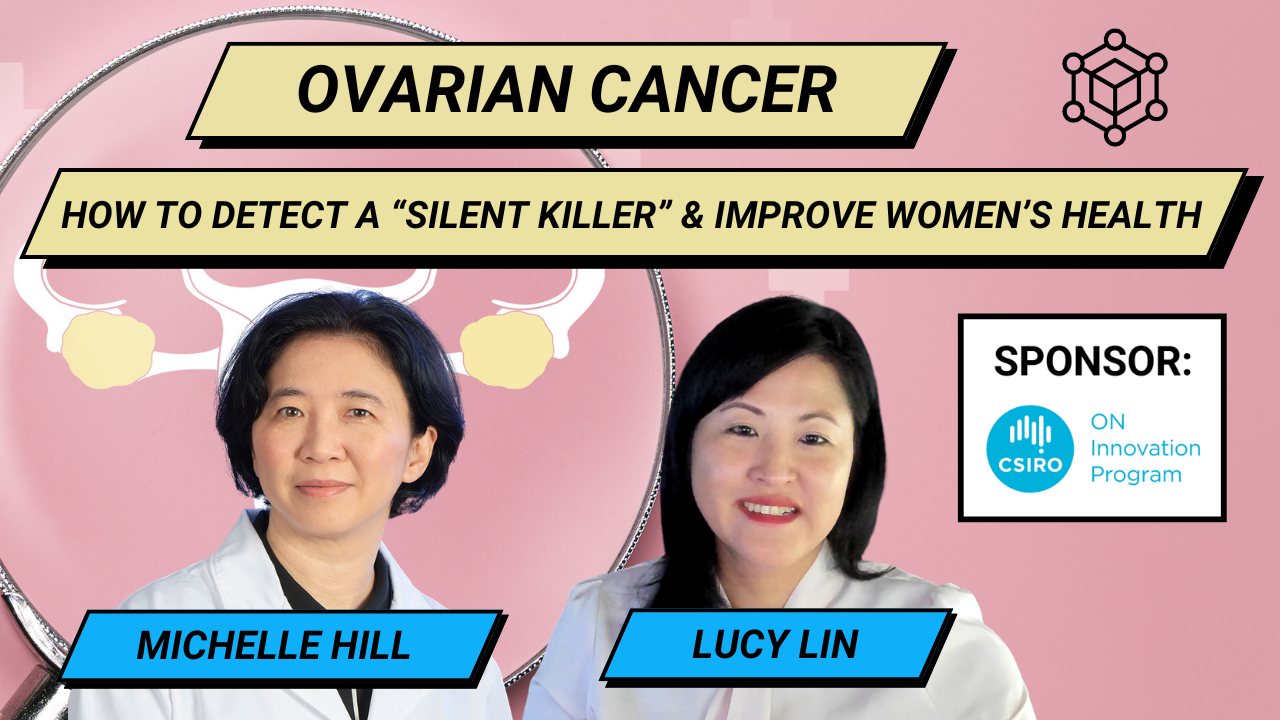
Ovarian cancer is one of the deadliest cancers in women’s health - not because it’s the most common, but because we usually find it too late and still don’t have a reliable screening test.
In my recent Emerging Tech Unpacked episode, “ Ovarian Cancer Detection with a Biochemist,” I sit down with Associate Professor Michelle Hill, founder and CEO of Proseek Bio, to explore why building a screening test is so difficult, how women are still being medically gaslit, and what it takes to turn deep biochemistry into a blood test that could change the story.
What is ovarian cancer, and why is it a “silent killer”?
Ovaries are two almond‑sized organs that sit deep in the pelvis, near the uterus and fallopian tubes. Ovarian cancer happens when cells in or near the ovary start growing out of control and can eventually spread through the abdomen or to other organs such as the lungs.
Michelle describes ovarian cancer as a silent killer because its early symptoms look like everyday life:
- Bloating
- Vague pelvic or abdominal pain
- Feeling unusually full quickly
- Needing to pee more often
- Fatigue or feeling “off”
These are common, nonspecific symptoms that many women experience regularly, which makes it difficult to recognise when something serious is going on. By the time ovarian cancer is diagnosed, most cases are already at stage III or IV, when the disease has spread, and treatment options are more limited.
The survival gap is stark:
- Early stage (I–II): more than 90% of women can survive five years after diagnosis.
- Late stage (III–IV): survival falls to under 30%.
Timing, not just treatment, becomes a life‑and‑death factor.
The shocking reality: diagnosis via major surgery
One of the most confronting facts in our conversation is how ovarian cancer is definitively diagnosed today.
Right now, the only way to confirm ovarian cancer is to surgically remove the ovary or mass and send it to pathology, where a specialist examines the tissue under a microscope. Surgeons operate, take out the ovary, and only then can they determine whether the mass was malignant (cancerous) or benign.
Because the pelvis can contain many benign cysts and masses that come and go, and because there are no accurate blood tests or biomarkers that reliably distinguish cancer from benign growths, clinicians often err on the side of caution and perform surgery. Some women go through major surgery, sometimes losing an ovary, facing weeks of recovery, and significant emotional stress - only to find out the mass was benign all along.
Michelle points out that scientific literature has even discussed “diagnostic surgery” as a screening tool for ovarian cancer, essentially recommending removal of ovaries for screening purposes, which she finds deeply shocking.
Why ovarian cancer is harder to detect than other cancers
We often hear about advances in breast cancer screening like mammograms and cervical cancer screening like Pap smears, and about dramatic improvements in survival for diseases such as childhood leukaemia, where survival has risen from around 10% in the 1960s to over 90% in many places today. So why has ovarian cancer lagged behind?
Michelle explains a few key reasons:
- Location and visibility: Skin and breast cancers can present as lumps you can see or feel, prompting earlier medical investigation. Ovarian cancer develops within the soft tissues, where lumps are not easily detected.
- Benign vs malignant masses: The core diagnostic question in many cancers is whether a mass is malignant (spreading, dangerous) or benign (non‑spreading, often harmless). In the ovary, this distinction is especially difficult to make using current imaging and blood tests.
- Biopsy risks: Because ovaries are small and masses can occupy most of the organ, taking a biopsy can risk spreading cancer cells if the mass is malignant, which surgeons understandably want to avoid.
These factors, combined with vague symptoms, make ovarian cancer particularly challenging to detect early.
Women’s health, clinical trials and medical gaslighting
Our discussion quickly broadened from ovarian cancer to the wider history of women’s health.
Michelle shared that women were not required to be represented in clinical research until 1993, and were often explicitly excluded because hormonal cycles were seen as “too variable” and because of childbearing potential. As a result, many medications were tested primarily in men and then given to women post‑approval, effectively making women the real‑world test subjects.
This has several consequences:
- Different disease presentations: Conditions like heart attacks can present differently in women, but doctors have historically been trained on male symptom profiles, leading to misdiagnosis or dismissal.
- Under‑researched women‑only conditions: Diseases such as ovarian cancer and endometriosis have been under‑studied, and for many years have lacked proper diagnostic tests.
- Medical gaslighting: When women present with pain or other symptoms, they are often told it is “just stress,” anxiety, weight, or “in their head.” Michelle calls this medical gaslighting, where real symptoms are minimised or dismissed because clinicians lack tools and training to address them.
We also discussed cultural roots of this problem, including the history of “hysteria,” where women’s physical and mental symptoms were blamed on the uterus and framed as emotional instability. This legacy still influences how women’s bodies are perceived and treated.
Michelle’s advice for women today is clear: advocate for yourself, seek second and third opinions if necessary, and remember that symptoms are real even when the system doesn’t yet have perfect diagnostic tools.
Proseek Bio: aiming to replace surgical diagnosis with a blood test
So how do we move from surgery‑based diagnosis to something less invasive and more scalable?
Michelle has spent over a decade building an academic proteomics platform, from studying the proteins in blood and, more specifically, the sugars decorating those proteins (glycoproteins). These sugar “decorations” can change protein function and carry detailed information about disease state.
She hypothesised that examining these detailed changes in glycoproteins would yield more accurate diagnostic tests than simply measuring protein levels. Inspired by earlier research on ovarian cancer biomarkers, she designed a pipeline that is explicitly translational and usable in routine pathology labs.
Key features of the Proseek Bio approach include:
- Multi‑biomarker panel: Instead of relying on a single marker like CA‑125, which is inaccurate and not specific to ovarian cancer, Michelle’s team measures a panel of protein and glycoprotein biomarkers that together distinguish malignant from benign masses.
- Existing lab workflow: From the doctor’s and patient’s perspective, the process looks like a standard blood test: a script, a blood draw, and results from the lab. The “magic” happens inside the test kit and algorithm used by the lab to analyse the sample.
- Better information, same sample: Michelle uses an analogy - the old test is like knowing a letter has arrived but not knowing what’s written inside. Proseek Bio’s test aims to read the message and say, “this looks cancerous” or “this looks benign.”
The goal is to help doctors decide whether a woman really needs ovarian cancer surgery, reducing unnecessary operations and enabling earlier treatment for those who do have cancer.
Behind this clinical workflow lies 15–20 years of scientific work and an equally demanding product development and manufacturing journey.
From lab bench to startup: CSIRO ON, funding and future skills
Michelle did not plan, at the start of her career, to become a founder, but her path into entrepreneurship emerged naturally from her desire to see her research become real products.
She founded Proseek Bio so that the collaboration and translational work could continue, and undertook an MBA and joined accelerator programs, including CSIRO ON Accelerate, to fill crucial knowledge gaps in company structure, intellectual property strategy, financial projections, milestone planning, and customer discovery.
Raising AU$1.5 million from aligned investors was a major milestone, but Michelle emphasises how much preparation and ecosystem support were required: understanding what to raise, what proof-of-concept work needed funding, and how to build the right team.
From a future skills perspective, she highlights several traits that matter for scientist‑entrepreneurs:
- Adaptability \- switching between research, business, regulation and stakeholder conversations.
- Teamwork \- “startup is a team sport,” not a solo hero journey.
- Resilience \- constantly solving new problems and moving from one challenge to the next.
- Creativity \- not just in art, but in imagining new diagnostic tests or better ways to do things.
- Empathy \- understanding patients, clinicians, investors and collaborators, and seeing where the real gaps in the system are.
She even jokes that customer discovery in entrepreneurship felt familiar because it’s essentially “experiments” with hypotheses and feedback loops, just like in science.
The future of women’s health diagnostics and ‘femtech’
Looking ahead, Michelle is optimistic that the next five years will bring multiple new diagnostic tests for women’s health. Research over the past two decades has built biobanks of blood samples and clinical data, and founders around the world are now using these resources to fast‑track test development.
Beyond her own work, we talked about the broader rise of femtech (technology related to female needs) and women‑centric data:
- Apps and wearables tracking cycles, pain, cardiovascular risk and menopause.
- Digital health platforms capturing sex‑specific data rather than treating women as “small men.”
- New guidelines and clinical trials that recognise women’s bodies as different, not inconvenient variations on a male default.
As more women lead companies, share their personal health experiences, and build tools they wish had existed for them, the ecosystem for women’s health is slowly but surely shifting.
Practical steps: know your normal and advocate for your health
We ended the conversation with some practical advice for listeners, regardless of gender.
Two simple but powerful actions:
- Know your normal: Keep notes on your phone or in a journal about symptoms, cycles, sleep, mood and any changes over time. This creates a personal baseline and gives you concrete information to take into appointments, so your experience is harder to dismiss.
- Advocate for yourself: If something feels wrong, it’s okay to seek second or third opinions. Doctors are highly trained, but they don’t know everything, and the system still has gaps, especially in women’s health. Your body is not “hysterical” - it is giving you data.
My main takeaway is that advocating for your health is not overreacting, it’s an investment in your future self.
To hear the full conversation, check out the Ovarian Cancer Detection with a Biochemist episode on the Emerging Tech Unpacked podcast.
Listen to the Podcast Episode:
🎙️ Website: https://www.emergingtechunpacked.com/episodes/ovariancancer
🎙️ YouTube: https://youtu.be/-FXSdS1m5po
🎙️ Apple Podcast: https://podcasts.apple.com/us/podcast/ovarian-cancer-how-to-detect-a-silent-killer/id1734061980?i=1000777403389
🎙️ Spotify: https://open.spotify.com/episode/6R3PY4txfBJ0noslcQvv4M?si=dv7PTkcETCiiHPvirp9aBA
🎙️ Insights Article: https://www.lucy-lin.com/insights/ovariancancer
Subscribe to Emerging Tech Unpacked on your favourite podcast platform or watch the episode on YouTube. Visit our website to learn more and join the conversation on social media!
🎙️ Website: https://www.EmergingTechUnpacked.com/
🎙️ YouTube: https://www.youtube.com/@emergingtechunpacked
🎙️ Apple Podcast: https://apple.co/4d6Hfoi
🎙️ Spotify: https://open.spotify.com/show/13chShsGWl7bqlQs0FZGvX?si=b7675f1bd5664c72
🔔 LinkedIn: https://www.linkedin.com/company/emergingtechunpacked
🔔 Instagram: https://www.instagram.com/emergingtechunpacked/
🔔 TikTok: https://www.tiktok.com/@emergingtechunpacked
🔔 Facebook: https://www.facebook.com/people/Emerging-Tech-Unpacked/100090565331236/
Support the Podcast!
💙 If you find this podcast valuable, consider keeping the podcast lights on and helping us cover some of our video and audio editing and operational costs: https://www.paypal.me/lucylin007007
☕ Or buy me a coffee (or three! :-): https://buymeacoffee.com/lucylin
👉 If this article was helpful, please share it and follow **Lucy Lin** and **Emerging Tech Unpacked** for more innovation and careers insights.
🚀 Contact me directly if you would like to partner or collaborate on any content, brand partnerships, sponsorship or speaking opportunities: https://www.lucy-lin.com/contact