
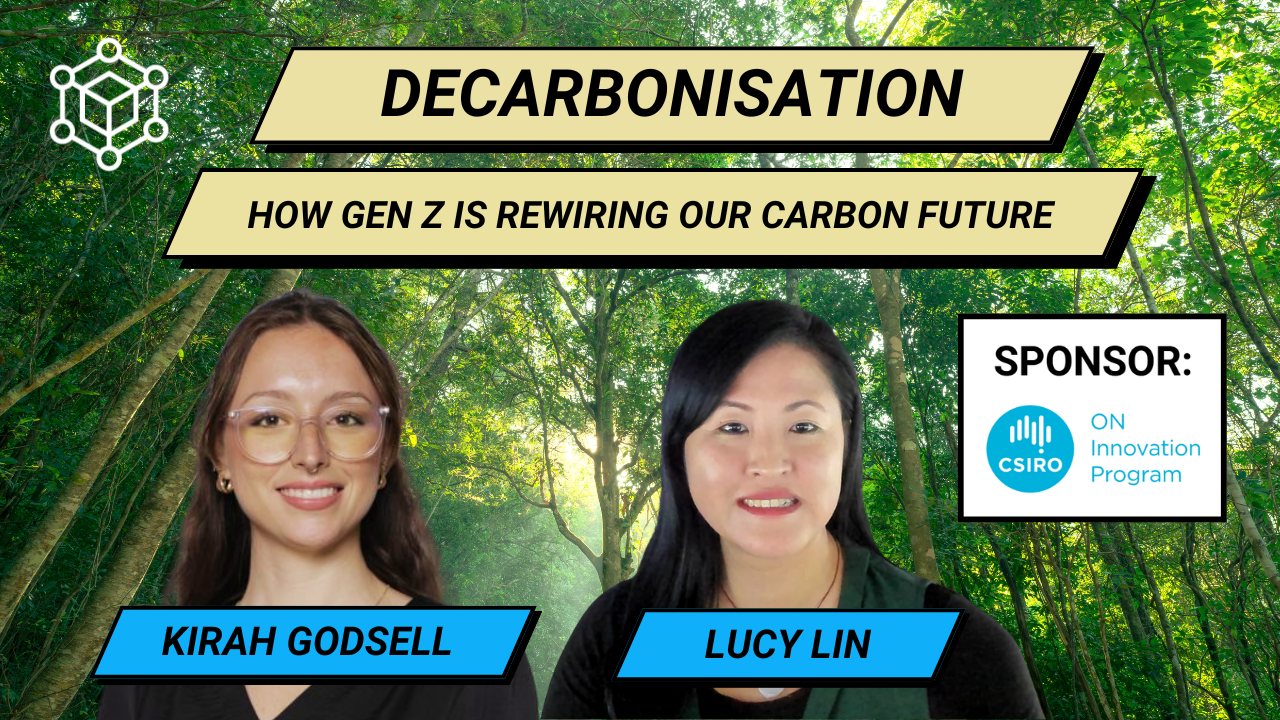
What does decarbonisation actually mean for your everyday life - and how does a Gen Z scientist end up trying to turn exhaust fumes into power from a university assignment and a garage?
In this episode of Emerging Tech Unpacked, host Lucy Lin sits down with Kirah Godsell, environmental scientist and co-founder of Air2Energy, to unpack decarbonisation in human language, through the eyes of a 22-year-old and a climate hardware founder.
Along the way, we explore climate anxiety, hope, greenwashing, and why “every little bit” still matters when systems change feels impossibly big.
“We Might See the End of the Great Barrier Reef”
Kirah’s story starts where many of ours don’t: with climate change as a childhood topic, not an adult surprise.
She grew up near a national park on Sydney’s Northern Beaches, spending time camping, at the beach, and surrounded by trees, while also learning about climate change in primary school science.
“We’ve grown up being taught about climate change throughout all of our education, and then we’ve also witnessed a lot of these climate catastrophes already.”
For her generation, those “catastrophes” aren’t abstract graphs - they’re the 2019-2020 bushfires, loss of habitat, and repeated mass bleaching events on the Great Barrier Reef.
Being told, as a teenager, that she might live long enough to “see the end of the Reef as we know it” left a mark.
“We only have one Earth, and it’s so important to look after it… I can’t wrap my head around people who don’t want to protect these environments.”
Learning #1: For Gen Z, decarbonisation isn’t a theoretical policy goal. It’s directly linked to places they love and whether those places still exist when they’re older.
From Pre Med to “Accidental” Climate Founder
When Kirah finished high school, she did what many bright science students do: she went into pre-medicine.
Then came a left turn. At the University of Technology Sydney, she took a Diploma in Innovation subject in which students had to solve a problem they cared about. She picked climate. Two strangers joined her group. They built a concept, pitched it… and that assignment quietly turned into the first version of Air2Energy.
“People often ask, how did you end up here? Honestly, I don’t really know either. It just kind of happened. I kept saying yes, and because I’m passionate about the mission, it still feels right.”
What began with a hedge trimmer engine in a garage evolved into a prototype that captures CO₂ from combustion exhaust and converts some of that energy back into electricity.
Learning #2: You don’t need a perfectly planned “climate career path”. Sometimes, a group assignment, the right collaborators and a willingness to keep saying “yes” are enough to pull you into impact.
Decarbonisation, Explained Like a Human
I usually ask an AI to explain big emerging tech concepts on this show - but for decarbonisation, I handed the microphone to Kirah.
Her explanation is beautifully simple:
“Decarbonisation is a big topic, but essentially at its root it means reducing the carbon footprint… We’re burning fossil fuels, and it’s pumping carbon dioxide into the air, and there’s too much of it, which is causing climate change.”
In everyday terms:
- Where does the CO₂ come from?
From burning fossil fuels in cars, boilers, power plants and industry - not from you and me breathing.
- Why is that a problem?
We’ve built up a thick “invisible blanket” of CO₂ around the planet, trapping heat and driving climate change, ocean acidification and extreme weather.
- What is decarbonisation?
Taking less carbon out of the ground to burn and getting carbon dioxide out of places it shouldn’t be - the atmosphere and oceans - by changing how we power things and sometimes literally pulling CO₂ out of exhaust or air.
She uses trees as the simplest mental model:
“Trees use carbon dioxide in photosynthesis, and then that takes carbon and puts it into the trees and into the ground. That’s a naturally occurring method of decarbonisation.”
Then she layers on tech: electric vehicles (EVs), renewable energy, and capture systems that sit right in the exhaust stream.
Learning #3: If you can explain decarbonisation using cars, trees and boilers, people actually lean in - you don’t need jargon to talk about serious climate work.
Air2Energy: Working in the Exhaust
Most climate stories focus on shiny new infrastructure - new EVs, new buildings, new plants. Kirah and her co founder decided to start somewhere less glamorous: the exhaust.
Air2Energy’s idea is straightforward but technically tough:
- Many industries and buildings will keep using combustion engines and gas boilers for years, even as we build clean alternatives.
- Instead of waiting for every asset to be replaced, can we retrofit systems onto existing exhausts to capture a chunk of their CO₂ and turn part of the waste energy into electricity?
This puts them right in the thick of “hard to abate” emissions:
- Commercial buildings with gas boilers (think shopping centres and office towers).
- Eventually, the marine sector, such as shipping and boats, once land based applications are proven.
“We still need to drive, we still need heat, so we’re looking at different energy sources and ways to work with what’s already there, rather than pretending we can switch it all off overnight.” (paraphrasing her explanation of EVs, boilers and capture tech)
A pivotal moment in this journey was their time in the CSIRO ON Innovation Program, which also sponsors this episode. Going through ON exposed the team to customer discovery, industry mentors and tough questions about where their technology could make the biggest near term impact. That process helped them pivot away from focusing purely on marine applications and toward land based commercial buildings, where they could pilot faster, prove the tech, and build a clearer business case.
Learning #4: Climate hardware is slow, messy and physical, but with the right support programs and partners, early stage founders can refine their direction and find the niches where their technology can make the biggest difference.
Hope, Doom and Being a Young Scientist in 2026
One of my favourite threads in the conversation is the emotional one: how do you stay sane when you’re young, scientifically literate, and well aware of the stakes?
Kirah is open about how confronting it is to hear scientists say the Reef may not survive in its current form through her lifetime. Yet she’s careful not to sink into doom or gloss over reality.
We talk about:
- Growing up with climate education plus constant bad news - bushfires, reef bleaching, floods, which causes greenwashing, consumer guilt and climate anxiety.
- The pressure of being labelled a “climate conscious young founder” when your actual project is one small piece of a huge puzzle.
- The importance of human connection in a world of AI, remote work and lingering post COVID loneliness.
Her prediction for the most important future skill?
“Human connection is going to become so important… As things become more and more automated, it’s so important to be able to create those human connections to address problems and work together.”
Learning #5: Climate tech still runs on very human fuel - connection, collaboration and the ability to keep going even when the data is scary.
What Can You Actually Do Now?
Kirah shares practical ways individuals and communities can plug into climate action, especially around decarbonisation:
- In cities: walk more where you can, consider EVs over time, and be conscious of what and how much you consume, especially energy and plastics.
- In communities: join or start community gardens and local environmental projects - they’re good for the climate and your social life.
- In careers: don’t underestimate the value of mixing science with innovation, communication and business skills - that’s exactly how her startup was born.
Her philosophy is incremental:
Small actions won’t fix everything alone, but multiplied across millions of people and paired with policy and tech shifts, they meaningfully change the trajectory.
Why This Conversation Matters
This decarbonisation episode isn’t “just” about exhaust pipes and prototypes. It’s about:
- How a generation raised with climate as background noise is choosing to respond.
- How we can talk about decarbonisation in ways that are understandable and motivating.
- How emerging tech, public research (like CSIRO and universities), and young founders can work together on real-world climate problems.
“We only have one Earth, and it’s so important to look after it.”
If you’re curious about climate tech, STEM careers, or what decarbonisation actually looks like beyond the buzzword from a Gen Z perspective, this episode will make you think.
Listen to the Podcast Episode:
🎙️ Website: https://www.emergingtechunpacked.com/episodes/decarbonisation
🎙️ YouTube: https://youtu.be/BSF9wJNZvP8
🎙️ Apple Podcast: https://podcasts.apple.com/au/podcast/decarbonisation-explained-gen-z-scientist-turning-exhaust/id1734061980?i=1000768924507
🎙️ Spotify: https://open.spotify.com/episode/6UDizaAD133IBMmWJm7KCL?si=0680a856801944e4
🎙️ Insights Article: https://www.lucy-lin.com/insights/decarbonisation
Subscribe to Emerging Tech Unpacked on your favourite podcast platform or watch the episode on YouTube. Visit our website to learn more and join the conversation on social media!
🎙️ Website: https://www.EmergingTechUnpacked.com/
🎙️ YouTube: https://www.youtube.com/@emergingtechunpacked
🎙️ Apple Podcast: https://apple.co/4d6Hfoi
🎙️ Spotify: https://open.spotify.com/show/13chShsGWl7bqlQs0FZGvX?si=b7675f1bd5664c72
🔔 LinkedIn: https://www.linkedin.com/company/emergingtechunpacked
🔔 Instagram: https://www.instagram.com/emergingtechunpacked/
🔔 TikTok: https://www.tiktok.com/@emergingtechunpacked
🔔 Facebook: https://www.facebook.com/people/Emerging-Tech-Unpacked/100090565331236/
Support the Podcast!
💙 If you find this podcast valuable, consider keeping the podcast lights on and helping us cover some of our video and audio editing and operational costs: https://www.paypal.me/lucylin007007
☕ Or buy me a coffee (or three! :-): https://buymeacoffee.com/lucylin

👉 If this article was helpful, please share it and follow **Lucy Lin** and **Emerging Tech Unpacked** for more innovation and careers insights.
🚀 Contact me directly if you would like to partner or collaborate on any content, brand partnerships, sponsorship or speaking opportunities: https://www.lucy-lin.com/contact