What does a Chief Scientist actually do, and why does quantum physics matter to your everyday life in Australia?
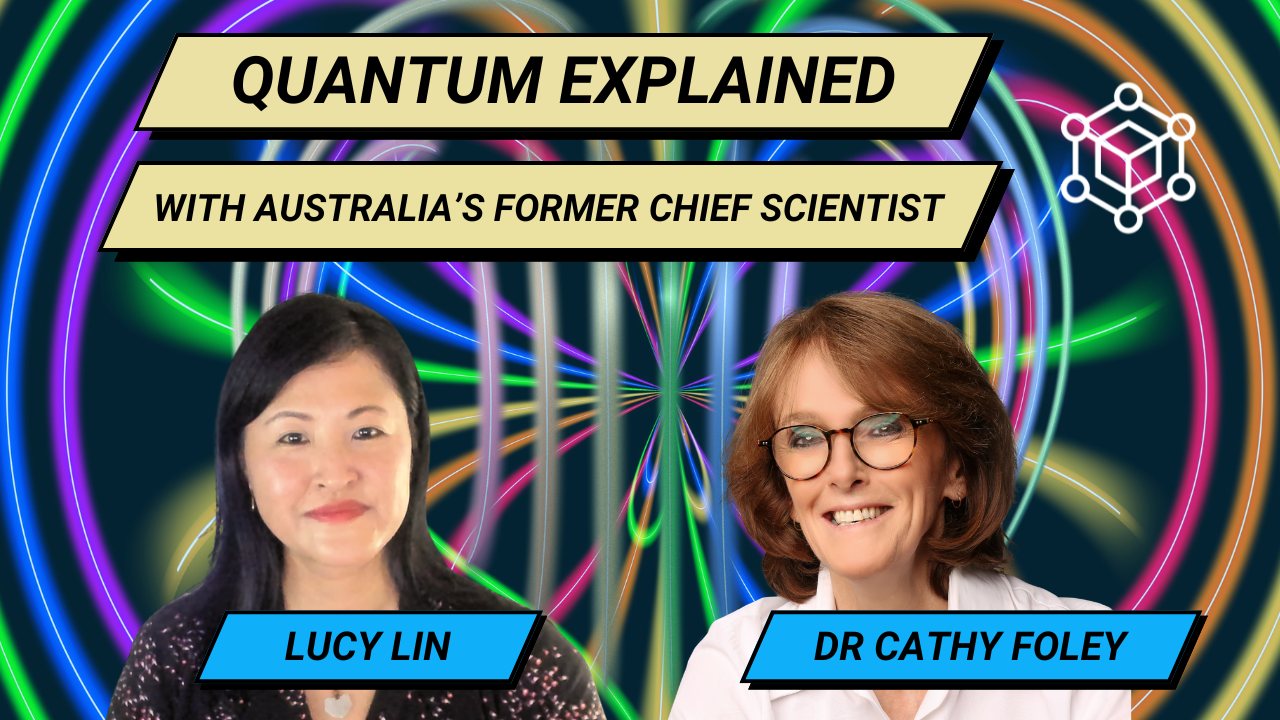
In this episode of Emerging Tech Unpacked, host Lucy Lin speaks to Dr Cathy Foley, physicist, CSIRO board member, and former Chief Scientist of Australia, to unpack how “weird” quantum ideas are rapidly becoming the engine of future technologies, industries and jobs.
Along the way, we explore science for humanity, Australia’s role in the global quantum race, and how to make sense of mind‑bending concepts like superposition, entanglement and Schrödinger’s cat.
“Science for Humanity”: Why Cathy Became a Scientist
Cathy’s journey starts with simple curiosity.
“I’ve always loved science, even as a kid - being adventurous, wondering about the world around us and how it works.”
She thought she’d become a high‑school science teacher, until university opened her eyes to what it really meant to be a scientist. That path led to a PhD in physics, early work on quantum materials, and eventually a 40‑year career with CSIRO, Australia’s national science agency.
For Cathy, the thread tying it all together is impact.
“For every researcher, you can always track where your work has made a contribution, and it’s so rewarding. That’s why people want to work in science, because their imagination and skills can lead to impacts that really help humanity be the best it can be.”
This is what she calls “science for humanity” - research that doesn’t just sit in journals, but turns into real‑world solutions.
Inside CSIRO: Solving Australia’s Biggest Challenges
CSIRO is more than just a research organisation, it’s a problem‑solving engine for the country.
“CSIRO was set up over 100 years ago to solve Australia’s greatest challenges… Australia needs a place it can go to and say: we have a problem, how can we solve this?”
From beating invasive species and improving biosecurity, to inventing plastic banknotes and contributing to the Wi‑Fi technology we now use daily, CSIRO has left fingerprints on many of Australia’s most important scientific breakthroughs.
Cathy’s own research career at CSIRO took her through:
- New magnetic materials and rare‑earth magnets
- Amorphous metals for low‑energy transformers
- High‑temperature superconductors and macroscopic quantum effects
These experiences gave her a unique perspective on how fundamental science slowly becomes everyday infrastructure.
How Do You Become Australia’s Chief Scientist?
Cathy never had “Chief Scientist” on a vision board, but her career made her a natural fit.
“I’m one of only ten people who’ve ever been Australia’s Chief Scientist. It’s an extraordinary privilege… the most amazing life experience, and I loved every minute of it. It was hard work, but absolutely worth it.”
The selection process is rigorous: public advertisement, longlisting, shortlisting, interviews, and finally a cabinet‑level appointment signed off by the Prime Minister and Governor‑General.
At first, she wasn’t even sure she wanted the job - she was already deeply engaged as CSIRO’s Chief Scientist, working on future‑focused science to prepare Australia for challenges no one had yet imagined. But she was encouraged to take the opportunity seriously, and the rest is history.
What Does Australia’s Chief Scientist Actually Do?
The role of Chief Scientist of Australia sounds grand, but Cathy breaks it into three clear responsibilities:
1) Provide evidence‑based advice to government:
“My role was to provide evidence‑based advice on anything any department or minister asked for. I didn’t have all the answers, but I needed the networks to access that knowledge.”
2) Champion Australian science at home and overseas:
Australia is small in population, but mighty in research output and quality.
“We’re about 0.3% of the world’s population but do roughly 3-4% of the world’s research. And it’s high‑quality work. Championing that was an enormous pleasure.”
3) Make the research system more efficient, effective and impactful
That meant working across vaccines, climate policy, defence, industry innovation, and quantum strategy, and often simultaneously.
“At one point I was on about 29 committees. Most days started very early and finished pretty late in the evening.”
It’s a role that sits at the intersection of science, policy and national strategy.
Quantum 101: From Slippery Dips to Quantum Leaps
Quantum physics is infamous for being confusing. Cathy’s gift is translating it without dumbing it down.
She starts by contrasting classical physics with quantum physics:
“In the classical world, energy changes in a smooth, continuous way, like pulling something up a slippery dip. In a quantum system, energy doesn’t change continuously. It goes in little steps. That’s why we call it a quantum leap.”
Those tiny “steps” underpin the first quantum revolution: the invention of transistors, lasers and LEDs, which all rely on controlling electrons and energy levels inside materials.
We already live in a world built on quantum - most people just don’t realise it.
The Second Quantum Revolution: Superposition and Entanglement
Today, we’re in what Cathy calls the second quantum revolution. Thanks to advanced tools that let us manipulate matter at the atomic and nanoscale, we can now exploit deeper quantum properties.
- On superposition:
“When we think of computers, bits are zero or one. Quantum asks: what if we operate while it’s not zero and not one yet - like a coin spinning in the air? We can do calculations in that probabilistic state.”
- On entanglement:
“You’ve probably heard it called ‘spooky action at a distance’. If I manipulate one atomic state over here, it can be entangled with another over there, so when I affect one, the other responds.”
Combining this theory with precise engineering lets us build new quantum technologies: from quantum computers and sensors to ultra‑secure communications.
Schrödinger’s Cat and the Black Box of Measurement
No quantum conversation is complete without Schrödinger’s cat.
Cathy uses it to explain the idea of measurement:
“If you’ve got something in a box, you don’t know what’s in there until you open it, that’s like measuring. Quantum technologies let us control things while they’re still ‘in the box’. Once you look, you’re back in the classical world, and you can’t just put the cat back in again. You have to start over.”
The power of quantum lies in what we can do before we open the box.
Explaining Quantum to a Five‑Year‑Old (And the Rest of Us)
When asked to put quantum into kid‑friendly language, Cathy uses a simple picture:
“A classical system is like a slippery dip: smooth and continuous. A quantum system is like steps - you don’t slide, you jump. That’s the easiest way to think about it.”
She also believes the next generation will think differently:
“Our kids will grow up thinking in a quantum way, probabilities instead of black‑and‑white. For them, steps and uncertainty will feel natural.”
This shift from black‑and‑white thinking to probability thinking has implications far beyond physics - from how we make decisions to how we design systems and policies.
Quantum Computers: Beyond the Hype
Quantum computers attract big headlines and even bigger myths. Cathy offers a grounded view.
“Quantum computers won’t replace classical computers. They’ll sit alongside them and do the kinds of calculations that are currently too hard or would take too long.”
Right now:
- Quantum devices are still early‑stage and noisy.
- They excel at specific types of complex optimisation and certain simulations.
- Large‑scale data‑crunching is still the domain of classical high‑performance computing, with quantum acting more like an accelerator for particular sub‑problems.
The future likely looks hybrid: powerful classical systems tightly integrated with specialised quantum hardware.
Australia in the Global Quantum Race
Despite its size, Australia is a serious player in the global quantum race.
Decades of investment in fundamental quantum research, strong university centres, CSIRO’s capabilities and a growing landscape of quantum startups have put the country on the map.
The National Quantum Strategy aims to:
- Build sovereign capability in quantum technologies
- Support industry adoption and commercialisation
- Prepare for quantum’s impact on security, encryption and critical infrastructure
- Grow the workforce and create new high‑value jobs
For Cathy, this is a natural extension of Australia’s track record:
“We’ve been investing in fundamental quantum research since the late 1990s and 2000s. Now we’re seeing that work come out of the lab into startups and industry collaborations.”
Why Quantum Matters for You
You don’t need to be a physicist to be affected by quantum.
From more secure communications and smarter logistics, to better medical diagnostics and cleaner energy systems, quantum tech is poised to shape the invisible infrastructure of everyday life.
As Cathy puts it:
“Most people don’t know how their car or their phone works. You just need to know how to use it. Quantum will be the same. And for people who want to work in this space, there’s room for many skills, not just physicists.”
Whether you’re in tech, policy, business, or just curious about the future, understanding quantum at a conceptual level will be increasingly important.
This Story Needs More Than One Episode…
As you can probably tell, one conversation with Cathy is nowhere near enough.
She’s such a fascinating guest and quantum is such a deep, fast‑moving field that we’ve turned this into a two‑part series. In Part Two, we go further into how quantum is moving out of the lab and into real‑world applications across industry, national security, jobs and Australia’s tech future.
If this episode has sparked your curiosity about quantum, Australia’s National Quantum Strategy, or what it takes to become a Chief Scientist, make sure you come back for Part Two of my conversation with Dr Cathy Foley.
Finally, please share this episode with 3 friends so they can begin their quantum understanding as well. Thank you, we appreciate it so much!
Listen to the Podcast Episode:
🎙️ Website: https://www.emergingtechunpacked.com/episodes/quantumexplained
🎙️ YouTube: https://youtu.be/lFbKWDF2jFc
🎙️ Apple Podcast: https://podcasts.apple.com/us/podcast/quantum-explained-with-australias-former-chief/id1734061980?i=1000758989851
🎙️ Spotify: https://open.spotify.com/episode/3bbULaOXUoYLjq3yXLLeet?si=JmSUHo5USm-QlzYYKOVjYQ
🎙️ Insights Article: https://www.lucy-lin.com/insights/quantumexplained
Subscribe to Emerging Tech Unpacked on your favourite podcast platform or watch the episode on YouTube. Visit our website to learn more and join the conversation on social media!
🎙️ Website: https://www.EmergingTechUnpacked.com/
🎙️ YouTube: https://www.youtube.com/@emergingtechunpacked
🎙️ Apple Podcast: https://apple.co/4d6Hfoi
🎙️ Spotify: https://spoti.fi/49TS1LG
🔔 LinkedIn: https://www.linkedin.com/company/emergingtechunpacked
🔔 Instagram: https://www.instagram.com/emergingtechunpacked/
🔔 TikTok: https://www.tiktok.com/@emergingtechunpacked
🔔 Facebook: https://www.facebook.com/people/Emerging-Tech-Unpacked/100090565331236/
Support the Podcast!
💙 If you find this podcast valuable, consider keeping the podcast lights on and helping us cover some of our video and audio editing and operational costs: https://www.paypal.me/lucylin007007
☕ Or buy me a coffee (or three! :-): https://buymeacoffee.com/lucylin
👉 If this article was helpful, please share it and follow **Lucy Lin** and **Emerging Tech Unpacked** for more innovation and careers insights.
🚀 Contact me directly if you would like to partner or collaborate on any content, brand partnerships, sponsorship or speaking opportunities: https://www.lucy-lin.com/contact